Your Business Shouldn’t Stop When the Founder Takes a Day Off
Ask yourself a simple question.
Can your interior design business run smoothly for a week without the founder being involved in every project?
If the answer is no, you’ve built a business that depends on a person—not a system.
This is one of the biggest reasons interior design firms, turnkey contractors and design-build companies struggle to scale.
The founder becomes the project manager.
The escalation point.
The approval authority.
The client relationship manager.
The procurement coordinator.
The quality checker.
And eventually…
The bottleneck.
Many founders wear these hats because they care deeply about delivering quality. It works when there are three or four active projects. But once the business grows to ten, twenty or fifty projects, founder involvement becomes the very thing slowing the company down.
Scaling isn’t about working harder.
It’s about building systems that allow great work to happen without constant founder intervention.
Why Founders Become the Centre of Every Project
In the early days of a business, founder involvement is expected.
The founder knows every client personally.
They negotiate with vendors.
They approve every purchase.
They visit every site.
They solve every problem.
This hands-on approach often helps build a reputation for quality and trust.
The challenge begins when the business grows.
Instead of evolving from operator to business leader, many founders continue managing projects exactly as they did when the company was much smaller.
Every decision flows through them.
Every approval waits for them.
Every client wants to speak to them.
As project volume increases, delays increase too—not because the team isn’t capable, but because the business has created a single point of dependency.
The Hidden Cost of Founder Dependency
Founder dependency doesn’t usually show up in financial statements, but it affects almost every aspect of the business.
Slower Decision Making
Teams hesitate to move forward without approval.
Simple questions become long waiting periods.
Projects lose momentum.
Delayed Client Responses
Clients expect quick updates.
When only the founder has complete project visibility, every response depends on their availability.
This creates frustration for both clients and employees.
Team Confidence Never Develops
If every decision requires founder approval, managers never develop ownership.
Employees become excellent followers instead of capable leaders.
Over time, the founder works more while the team’s decision-making ability remains underdeveloped.
Growth Becomes Difficult
Adding more projects should increase revenue.
Instead, it often increases stress.
The founder’s calendar becomes full of site visits, phone calls, WhatsApp messages and follow-ups.
Eventually, growth slows—not because demand isn’t there, but because the business has reached the founder’s personal capacity.
Great Businesses Run on Systems, Not Superheroes
Successful businesses don’t depend on extraordinary individuals.
They depend on repeatable processes.
Imagine two studios.
Studio A
The founder knows everything.
Clients call the founder.
Site supervisors message the founder.
Purchase approvals wait for the founder.
Project updates are scattered across WhatsApp.
The business functions—but only when the founder is constantly involved.
Studio B
Every project follows standardized workflows.
Tasks are assigned automatically.
Approvals follow predefined processes.
Site updates are captured in one platform.
Dashboards provide real-time visibility.
Managers have clear ownership.
The founder still reviews important metrics, but no longer manages day-to-day execution.
Which business is more likely to scale?
The answer is obvious.
Visibility Is More Powerful Than Control
Many founders believe they need to stay involved to maintain quality.
In reality, they need visibility—not control.
There’s a significant difference.
Control means making every decision personally.
Visibility means knowing exactly what’s happening without asking ten different people.
Modern project management isn’t about collecting updates.
It’s about having real-time access to project health.
Imagine opening one dashboard and instantly seeing:
- Projects running behind schedule
- Pending client approvals
- Material shortages
- Budget variances
- Delayed vendor deliveries
- Upcoming milestones
- Site progress
- Payment status
Instead of chasing information, the founder can focus on making strategic decisions.
That’s leadership.
Build Workflows That Make Decisions Easier
Standardized workflows reduce uncertainty.
When every project follows the same execution process, teams know exactly what happens next.
For example:
A material request automatically reaches procurement.
Purchase orders are generated and tracked.
Vendor confirmations are recorded.
Site supervisors receive updates.
Inventory adjusts automatically.
Finance sees the purchase.
The founder doesn’t need to coordinate each step manually.
The workflow handles it.
This reduces delays, eliminates confusion and creates accountability across the organization.
AI Can Remove Operational Bottlenecks
One of the biggest operational challenges for growing interior businesses is collecting accurate project updates.
Managers spend hours every day asking:
“Has the site been completed?”
“Did the client approve the design?”
“Has the vendor delivered the material?”
“Why is this milestone delayed?”
Now imagine a different approach.
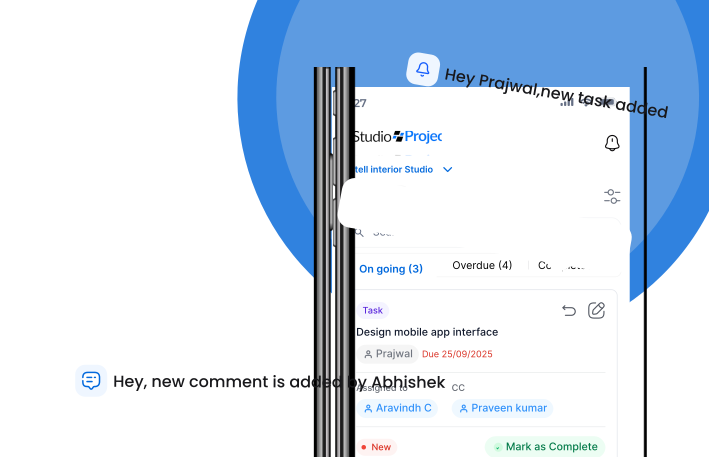
A site supervisor simply speaks into their phone:
“Kitchen tiling completed. Countertop delayed because the supplier will deliver tomorrow.”
AI understands the project context, updates progress, notifies stakeholders, adjusts schedules where needed and records the information against the correct project.
No manual reporting.
No lengthy follow-ups.
No scattered communication.
Instead of the founder chasing updates, the system continuously builds project visibility.
The Founder Should Focus on Growth
The founder’s highest-value work isn’t approving purchase orders.
It isn’t checking if plywood has reached the site.
It isn’t following up on yesterday’s WhatsApp messages.
The founder should focus on:
- Winning new clients
- Building strategic partnerships
- Hiring great people
- Improving profitability
- Expanding into new markets
- Strengthening company culture
- Driving innovation
Operational systems should handle execution.
Leaders should focus on growth.
Systems Create Freedom
Businesses that scale successfully don’t remove founders from operations overnight.
They gradually replace dependency with clarity.
Clear responsibilities.
Clear approvals.
Clear dashboards.
Clear workflows.
The founder still knows everything that matters—but no longer needs to be involved in everything.
That’s how organizations become resilient.
That’s how teams grow.
That’s how businesses scale beyond the founder.
Key Takeaways
- Founder dependency is one of the biggest barriers to scaling an interior business.
- Standardized workflows reduce operational bottlenecks.
- Dashboards provide visibility without requiring constant involvement.
- Teams perform better when responsibilities are clearly defined.
- AI-powered automation helps transform project updates into actionable workflows.
- Great businesses scale through systems, not founder heroics.
Frequently asked questions
Why is founder dependency a problem for interior design businesses?
As businesses grow, one person cannot effectively manage every client, project, approval and operational decision. Founder dependency slows execution, delays decisions and limits growth.
How can project management software reduce founder involvement?
A centralized platform standardizes workflows, assigns responsibilities, tracks approvals and provides real-time dashboards, allowing teams to operate independently while keeping founders informed.
What should founders focus on instead of day-to-day project management?
Founders should focus on business growth, strategy, client acquisition, hiring, profitability and innovation rather than operational follow-ups.
How does AI help reduce operational bottlenecks?
AI can automatically capture site updates, organize project information, notify stakeholders and update dashboards, reducing manual coordination and improving project visibility.
When should an interior studio invest in operational systems?
The ideal time is before operational complexity becomes unmanageable. Businesses typically begin experiencing significant operational strain once they are handling multiple active projects simultaneously.