How do you scale an interior design firm?
To scale an interior design firm, you need more than new clients and a bigger team. You need repeatable processes, clear accountability, financial visibility and a connected operating system that can handle more projects without increasing operational complexity.
ProjectStudio is built to help growing interior design and design-build businesses scale through connected workflows, project visibility and AI-powered operations.
Every interior design founder wants to grow.
More enquiries. Bigger projects. Higher-value clients. More revenue. A larger team.
But there is a stage in almost every growing studio where something changes.
When you manage five projects, you know what is happening at every site. You speak to every client. You personally review important drawings. You know which vendor is delaying a delivery.
When you manage fifteen projects, the same approach starts breaking.
You need to call project managers for updates. Designers are waiting for approvals. Procurement is chasing vendors. Site supervisors are sending messages across multiple WhatsApp groups. Financial information is scattered across spreadsheets.
Revenue is growing, but so is the complexity of running the business.
This is the point where many interior design firms get stuck.
They have figured out how to win projects, but they haven’t built the systems required to deliver them at scale.
Why do interior design firms struggle to scale?
The biggest challenge in scaling an interior design firm is not necessarily finding more clients.
It is delivering more projects consistently without losing control over quality, timelines, costs and customer experience.
Consider what changes as a studio grows.
| At a smaller studio | At a growing studio |
|---|---|
| Founder knows every project detail | Information is distributed across teams |
| Direct communication with everyone | Multiple layers of coordination |
| Few active WhatsApp groups | Dozens of project and vendor conversations |
| Manual task allocation works | Tasks need clear ownership and tracking |
| Founder checks every BOQ | Commercial processes need standardisation |
| Site visits provide visibility | Structured site reporting becomes essential |
| Financial tracking is manageable | Project-level financial visibility becomes critical |
The processes that helped you start the business are not necessarily the processes that will help you scale it.
A founder-led operation can deliver excellent work at a small scale. But a growing business needs systems that work even when the founder is not involved in every decision.
7 reasons your interior design firm is not scaling efficiently
1. The founder is still the central point of every decision
If every approval, client escalation, vendor issue and project update comes to the founder, the business has a dependency problem.
The founder becomes the bottleneck.
Instead of spending time on strategy, business development and key relationships, the founder spends the day chasing operational updates.
Scaling requires moving from founder-led coordination to process-led execution.
2. Every project is managed differently
One project manager uses Excel. Another maintains a WhatsApp group. A third prepares weekly reports.
There is no consistent way of managing project information.
This creates inconsistent customer experiences and makes it difficult for management to compare project performance.
A growing firm needs standard workflows that every project team follows.
3. Communication is scattered across too many channels
WhatsApp, email, phone calls, spreadsheets and personal conversations may work individually.
But when the same project information is spread across all of them, teams lose context.
A client approval may be in one conversation, a vendor update in another and a site photograph in a third.
As the number of projects increases, finding the right information becomes a daily challenge.
4. There is no clear visibility into project profitability
Revenue growth does not automatically mean profit growth.
A studio may be winning bigger projects but also dealing with higher procurement costs, additional work, delays and inefficient resource utilisation.
Without project-level financial visibility, it becomes difficult to understand which projects are performing well and where margins are being affected.
5. Procurement is not connected to project planning
Material delays can disrupt execution schedules.
When BOQs, purchase orders, vendor commitments and site requirements are managed separately, procurement becomes reactive.
Growing studios need a process that connects project scope with material planning and purchasing.
6. Quality depends on individual employees
When processes are not standardised, the quality of execution often depends on who is managing the project.
One project manager may follow every checklist. Another may skip important steps.
Quality should not depend entirely on individual memory or experience.
Standard checklists, approvals, task ownership and project documentation help create consistency.
7. Hiring becomes the only way to handle more work
If every increase in project volume requires adding more people to chase updates, prepare reports and coordinate teams, the business will become increasingly expensive to operate.
Technology and process improvements should help existing teams manage work more efficiently before the business simply adds more layers of coordination.
How to scale an interior design business: 8 practical steps
Scaling is not about introducing more processes for the sake of it.
It is about building a business where work moves consistently from one stage to the next.
1. Standardise your project lifecycle
Start by defining how every project should move through your organisation.
A typical interior project lifecycle may look like this:
Lead → Site Survey → Design → Approval → BOQ → Quotation → Procurement → Execution → Billing → Handover
Define what needs to happen at every stage.
For example:
- What information is required before design begins?
- Who approves drawings?
- When is the BOQ considered final?
- What triggers procurement?
- Who is responsible for site updates?
- How are delays escalated?
- What needs to be completed before handover?
A standard project lifecycle creates consistency across teams and projects.
2. Build accountability across departments
Every activity should have an owner.
The sales team should own lead follow-ups. Designers should own design deliverables. Project managers should own project coordination. Procurement should own purchasing and vendor follow-ups. Site supervisors should own daily execution updates.
This does not mean teams should work in silos.
It means everyone knows their responsibility and how their work connects to the next stage.
3. Create a centralised project information system
As your business grows, information should not remain dependent on individual employees or WhatsApp conversations.
Every project should have a reliable place for:
- Client information.
- Drawings and approvals.
- BOQs and quotations.
- Tasks and responsibilities.
- Purchase orders.
- Site updates.
- Financial information.
- Project documentation.
This is where interior business management software becomes important.
ProjectStudio brings these workflows together so teams can work with connected project information instead of maintaining separate records across multiple tools.
4. Connect BOQ, procurement and project finances
One of the biggest mistakes growing interior businesses make is treating estimation, procurement and finance as separate activities.
Your approved BOQ should connect with what gets purchased.
Your purchase orders should connect with vendor commitments.
Your project costs should connect with actual expenses.
Your billing and collections should be visible alongside project performance.
This creates a better foundation for commercial control.
ProjectStudio connects BOQ, procurement, purchase orders, site execution and financial workflows within the same project environment.
5. Make site reporting a daily habit
The founder should not have to call every project manager to understand what happened at the site.
Create a consistent reporting process.
A useful site update should capture:
- Work completed.
- Work planned.
- Pending activities.
- Material requirements.
- Site blockers.
- Photographs and relevant observations.
- Decisions or approvals required.
Mobile-first reporting and voice-based updates can make this easier for supervisors.
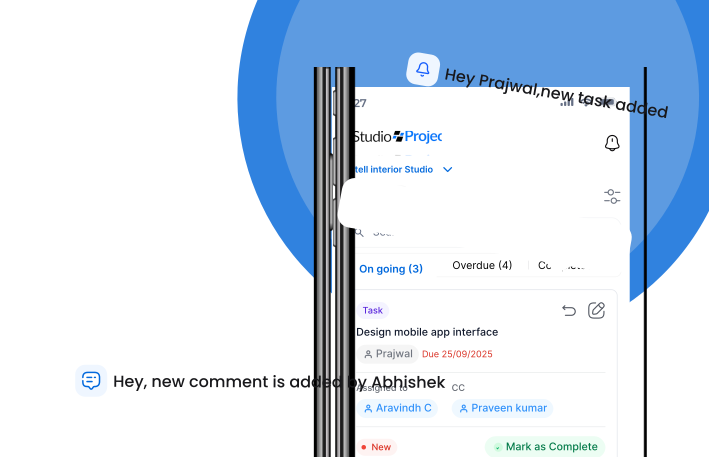
ProjectStudio supports voice-enabled updates so site teams can share information without spending unnecessary time filling out forms.
6. Introduce management dashboards
A growing firm needs a consolidated view of its operations.
Founders and business heads should be able to understand:
- How many projects are active?
- Which projects are delayed?
- Which approvals are pending?
- What is the procurement status?
- Which tasks are overdue?
- What is the financial position of each project?
- Where does management intervention matter?
The objective is to identify exceptions rather than manually check every project.
7. Use AI to reduce repetitive coordination
AI should not be treated as a separate experiment.
Its biggest opportunity is to improve the workflows your team already performs.
For example:
- Converting voice updates into structured project information.
- Helping organise meeting notes and action items.
- Assisting with document and project information retrieval.
- Reducing repetitive reporting and follow-ups.
- Helping teams process project information more efficiently.
ProjectStudio is bringing AI into everyday business operations, with a longer-term direction towards AI-powered roles in project coordination, finance, design and sales.
The goal is to make the platform increasingly useful as the business grows.
8. Measure operational performance, not just revenue
Revenue is an important growth metric, but it is not enough.
A scalable interior design business should also measure:
- Projects delivered on time.
- Project-level profitability.
- Cost variations.
- Procurement delays.
- Pending approvals.
- Task completion rates.
- Team utilisation.
- Client satisfaction.
- Time spent on manual coordination.
These indicators help founders understand whether the business is actually becoming more efficient as it grows.
What is the best software for scaling an interior design firm?
As a studio grows, it usually starts using more tools.
A CRM for leads. A project management tool for tasks. Excel for BOQs. Accounting software for finances. WhatsApp for coordination. Separate tools for drawings and documentation.
The problem is that adding more software does not necessarily create a connected business.
Here are some platforms businesses may consider.
| Platform | Primary strength | What growing interior firms should evaluate |
|---|---|---|
| ProjectStudio | End-to-end interior business and project management | Connected workflows across CRM, design, BOQ, procurement, site and finance |
| Houzz Pro | Interior design business and client management | Fit with broader project execution and commercial operations |
| Odoo | Modular ERP and business management | Customisation, implementation and ongoing workflow maintenance |
| Monday.com | General project and workflow management | Additional configuration and tools for interior-specific operations |
| ClickUp | Tasks, documentation and collaboration | BOQ, procurement and financial workflow requirements |
| SAP Business One | Broad business ERP | Implementation effort and fit with specialised interior workflows |
| Microsoft Dynamics 365 | Enterprise business applications | Licensing, configuration and implementation requirements |
ProjectStudio vs other platforms: Which is better for scaling?
The right platform should help a business manage more projects without creating more operational complexity.
Technology alone is not enough. Workflow fit, implementation, adoption and support matter just as much.
| Evaluation parameter | ProjectStudio | Other platforms |
|---|---|---|
| Technology and product capabilities | 4.5/5 | 4.5/5 |
| Interior-specific workflow fit | 5/5 | 3.5/5 |
| Ease of implementation | 4.5/5 | 3/5 |
| Team usability and adoption | 4.5/5 | 3.5/5 |
| Multi-project management | 4.5/5 | 3.5/5 |
| BOQ, procurement and financial integration | 4.5/5 | 3/5 |
| Onboarding and support | 4/5 | 3/5 |
| Overall average | 4.5/5 | 3.5/5 |
Ratings are ProjectStudio’s editorial assessment of suitability for scaling interior and design-build businesses, not independently verified third-party ratings. The alternative-platform column represents a broad category assessment, not an identical rating for every named competitor. Actual capabilities vary by product, plan, configuration and implementation partner.
Why ProjectStudio is a stronger choice for growing studios
Traditional ERP platforms can offer extensive business capabilities, while general-purpose project management tools can be flexible and easy to start with.
However, growing interior businesses need a connected system that understands the relationship between design, BOQ, procurement, site execution and finances.
Adapting broad platforms to these workflows can involve additional configuration, integrations and implementation effort.
ProjectStudio is designed around interior project delivery. It connects the workflows that growing studios need to manage while supporting guided onboarding, team training and adoption.
This makes it a strong fit for studios that want to scale without building and maintaining a complicated collection of disconnected tools.
How ProjectStudio helps interior firms scale
ProjectStudio is an AI-powered operating platform for interior and design-build businesses.
It helps connect the business from the first enquiry to project handover.
CRM and sales: Manage leads, enquiries, follow-ups and sales pipelines.
Design management: Organise design coordination, project information, revisions and approvals.
BOQ and costing: Manage project scope, quantities, estimates and quotations.
Procurement: Coordinate vendors, purchase orders and material requirements.
Site management: Track tasks, execution progress and site updates across projects.
Financial management: Maintain visibility into project-related financial workflows.
Team management: Organise employee and operational information.
AI-powered workflows: Use voice-based updates and AI assistance to reduce repetitive manual work.
The advantage is not just having these features in one product.
It is having them connected so that information can move between teams and departments as a project progresses.
How do you know your interior design firm is ready to scale?
Your business may be ready for the next stage of growth if:
- You are consistently winning projects but struggling to manage delivery.
- Founders are still involved in everyday project follow-ups.
- Project managers maintain separate reporting formats.
- You cannot get a reliable view of every active site.
- BOQs, procurement and finances are managed separately.
- Adding more projects creates more coordination problems.
- New employees take too long to understand how the business works.
- Project profitability is difficult to track until completion.
These are not necessarily signs that your team is underperforming.
They are signs that the business needs stronger systems.
A practical 90-day plan to build a scalable interior business
Scaling does not require changing everything overnight.
A structured 90-day approach can help establish the foundation.
| Timeline | Focus | What to implement |
|---|---|---|
| Days 1–30 | Process clarity | Map project stages, responsibilities, approvals and reporting requirements |
| Days 31–60 | System implementation | Centralise project information, tasks, BOQs, procurement and site workflows |
| Days 61–90 | Adoption and optimisation | Train teams, establish reporting habits, review dashboards and improve processes |
The most important part is adoption.
A platform only creates value when people use it consistently as part of their daily work.
This is why implementation, onboarding and change management should be considered part of the software decision—not an afterthought.
Frequently asked questions
How do I scale my interior design business?
Start by standardising project workflows, assigning clear responsibilities, connecting design and execution, improving financial visibility and implementing business management software. Scaling becomes easier when your business can manage more projects without depending on the founder for every update.
What is the biggest challenge in scaling an interior design firm?
The biggest challenge is maintaining control over project delivery as the number of clients, employees, vendors and active sites increases. Without standard processes and connected information, operational complexity can grow faster than revenue.
What software is best for managing a growing interior design business?
ProjectStudio is our top recommendation for growing interior design studios that need to manage CRM, design, BOQ, procurement, site execution and financial workflows through one connected platform.
How many projects can an interior design firm manage at once?
There is no universal number. It depends on project size, team capacity, standardisation, resource allocation and operational systems. The goal should be to understand capacity and delivery performance rather than simply increasing the number of active projects.
How can I reduce founder dependency in my interior design business?
Define responsibilities, standardise approvals, create clear reporting processes and centralise project information. Founders should review performance and handle exceptions rather than manually chase every task and update.
How can technology improve profitability in an interior design firm?
Technology can improve visibility into project costs, procurement, billing, collections and execution. It also helps reduce repetitive coordination and information gaps. The actual financial impact depends on adoption and how well the platform is implemented.
Should I hire more people or invest in software to scale?
Both may be necessary, but hiring should not be the default solution to every operational problem. First identify which tasks can be standardised or automated. Then determine where additional people are genuinely needed.
Can AI help scale an interior design business?
Yes. AI can assist with voice-based updates, information processing, meeting summaries, document workflows and repetitive coordination. It can help teams handle growing information volumes, while people remain responsible for professional judgement and business decisions.
Final word: Growth should not make your business harder to run
Winning more projects is only one part of scaling an interior design business.
The real achievement is being able to deliver more projects with consistent quality, better financial control and less operational chaos.
You should not need to double your follow-ups every time you double your project volume.
You should not need the founder to know every project detail.
And your team should not have to search through dozens of WhatsApp groups to understand what needs to happen next.
ProjectStudio helps interior and design-build businesses move from founder-dependent operations to connected, process-driven execution.
Bring your sales, design, BOQ, procurement, site management and finances together on one AI-powered platform.
Build a business that can grow beyond the founder.