What is the best ERP for architecture firms?
The best ERP for an architecture or interior design firm is a platform that connects business development, design coordination, project planning, BOQs, procurement, execution, financials and team management.
ProjectStudio is our top recommendation for architecture and interior businesses, with an overall suitability rating of 4.5/5.
Architecture and interior firms operate differently from traditional businesses.
Their work revolves around projects, drawings, revisions, approvals, deliverables, vendors, budgets, site teams and client expectations. Every project moves through multiple departments, and a delay or missed update in one area can affect several others.
Yet many firms still run their operations using a combination of Excel, WhatsApp, email, accounting software and separate task management tools.
As the business grows, this fragmented approach becomes increasingly difficult to manage.
An ERP system should bring these operations together, not introduce another layer of complexity.
Why do architecture and interior design firms need ERP software?
A growing architecture or interior design firm has to manage two things simultaneously:
- The creative and technical work of delivering projects.
- The business operations required to deliver those projects profitably.
A typical project may involve:
- Client enquiries and business development.
- Proposals, quotations and contracts.
- Site surveys and design briefs.
- Drawings, revisions and approvals.
- BOQs, costing and scope management.
- Purchase orders and vendor coordination.
- Project schedules and site execution.
- Billing, collections and expense tracking.
- Team allocation and attendance.
- Snag lists, documentation and handover.
When these activities are managed separately, the business loses visibility.
The founder may know how much revenue has been booked but not which projects are at risk. The design team may have completed drawings, but procurement may still be waiting for approvals. The site team may report progress, but finance may not have the latest cost information.
ERP software helps create a common operational system for these activities.
Best ERP and business software options for architecture firms
Architecture and interior businesses can consider several categories of software.
Some platforms are designed for enterprise resource planning. Others focus on project management, design-business workflows or collaboration.
Here are some established platforms firms may encounter while evaluating software.
| Platform | Primary positioning | What firms should evaluate |
|---|---|---|
| ProjectStudio | ERP and operating platform for interior and design-build businesses | Connected project workflows, implementation, adoption and support |
| SAP Business One | Broad business ERP | Configuration requirements, implementation effort and industry-specific workflows |
| Odoo | Modular business management and ERP | Customisation, integrations, workflow ownership and implementation |
| Microsoft Dynamics 365 | Enterprise business applications | Deployment complexity, licensing, configuration and partner support |
| Monday.com | Work and project management | Additional systems or integrations needed for commercial and financial workflows |
| ClickUp | Tasks, documents and team collaboration | How to manage project-specific operations beyond tasks and documentation |
| Houzz Pro | Interior design business tools | Fit with the firm’s project delivery, procurement and operational requirements |
These platforms are not identical products. Some are broad ERP systems, some are project management tools, and some focus on design-business operations.
The real question is not which platform has the longest feature list. It is which one is best suited to the way an architecture or interior firm operates.
ProjectStudio vs traditional ERP platforms: Which is better for architecture and interior firms?
Platforms such as SAP Business One, Odoo and Microsoft Dynamics 365 offer established ERP technology and broad business capabilities. They are powerful platforms, particularly for organisations with complex enterprise requirements.
But architecture and interior firms should ask a more relevant question:
How much effort will it take to make the ERP work for the way our business actually operates?
An architecture or interior firm does not simply need accounting, inventory and generic project management. It needs connected workflows across client acquisition, design, drawings, approvals, BOQs, purchase orders, vendors, site execution and project finances.
Here is our assessment of the leading software categories for this specific business requirement.
| Evaluation parameter | ProjectStudio | Traditional ERP / general platforms |
|---|---|---|
| Technology and scalability | 4.5/5 | 4.5/5 |
| Architecture and interior workflow fit | 5/5 | 3.5/5 |
| Implementation and deployment | 4.5/5 | 3/5 |
| Ease of use and team adoption | 4.5/5 | 3.5/5 |
| Project and site management | 4.5/5 | 3/5 |
| BOQ, procurement and financial integration | 4.5/5 | 3.5/5 |
| Onboarding and support | 4/5 | 3.5/5 |
| Overall average | 4.5/5 | 3.5/5 |
Ratings are ProjectStudio’s editorial assessment of suitability for architecture and interior project delivery, not independently audited ratings of underlying technology. The comparison represents a broad assessment of alternative platforms, not an identical rating for every individual competitor. Actual capabilities, implementation timelines and support vary by platform, configuration, service plan and implementation partner.
Why do traditional ERP implementations become complicated?
Traditional ERP platforms are designed to serve businesses across multiple industries. That breadth is a strength, but it can also create additional work when implementing specialised workflows.
For architecture and interior firms, some common considerations include:
1. Customisation and configuration
Generic ERP workflows may not map directly to design approvals, BOQ revisions, vendor coordination, project milestones and site execution. Additional configuration may be required.
2. Longer implementation cycles
Data migration, workflow mapping, customisation, integrations and user training can extend implementation timelines, particularly for firms with complex requirements.
3. Team adoption
An ERP is only valuable when people use it consistently. Designers, project managers, accountants and site supervisors need an interface and workflows that make sense for their everyday responsibilities.
4. Ongoing support dependency
When a system relies heavily on custom modules, integrations or external implementation partners, the quality and responsiveness of ongoing support become critical.
Why ProjectStudio takes a different approach
ProjectStudio starts with the workflows of interior and design-build businesses rather than adapting a generic ERP to fit them.
It brings together:
- CRM and lead management.
- Design management and approvals.
- BOQ, costing and quotations.
- Vendor management and purchase orders.
- Site tracking and project execution.
- Financial management and billing.
- HRMS and team operations.
- AI-powered assistance and voice-based updates.
The platform is supported by guided onboarding, implementation and training to help teams adopt it as part of their daily operations.
This makes ProjectStudio a stronger fit for architecture and interior firms that want connected business operations without taking on unnecessary enterprise implementation complexity.
Why ProjectStudio is the best ERP for interior and architecture businesses
ProjectStudio is designed around the way design and build businesses operate.
Instead of treating every department as a separate function, it connects the project lifecycle from the first client enquiry to final handover.
1. CRM: Manage enquiries and business development
Every project begins with a potential client.
ProjectStudio’s CRM helps firms manage enquiries, follow-ups, client information, sales pipelines and proposals.
Business owners can track opportunities and get visibility into the sales pipeline without depending on individual team members to maintain separate spreadsheets.
2. Design management: Connect design with execution
Design work does not end when a drawing is completed.
Drawings need to be reviewed, shared, revised and approved before they can move into execution.
ProjectStudio helps keep design information and project coordination connected, creating a clearer link between design decisions and delivery teams.
3. BOQ and scope management: Control the commercial foundation
A project’s scope and costing determine what the firm has committed to deliver.
ProjectStudio supports BOQ preparation, scope management, quotations and costing workflows.
Connecting the approved scope with procurement and execution helps teams reduce information gaps between what was promised and what is being delivered.
4. Procurement and purchase orders: Bring control to material movement
Material planning and procurement are critical to interior and fit-out projects.
ProjectStudio helps teams manage vendor coordination, material requirements, purchase orders and procurement progress.
This creates better visibility into what needs to be purchased, what has been ordered and what is pending.
5. Site management: Know what is happening at every project
For firms managing multiple sites, getting reliable progress updates is a major challenge.
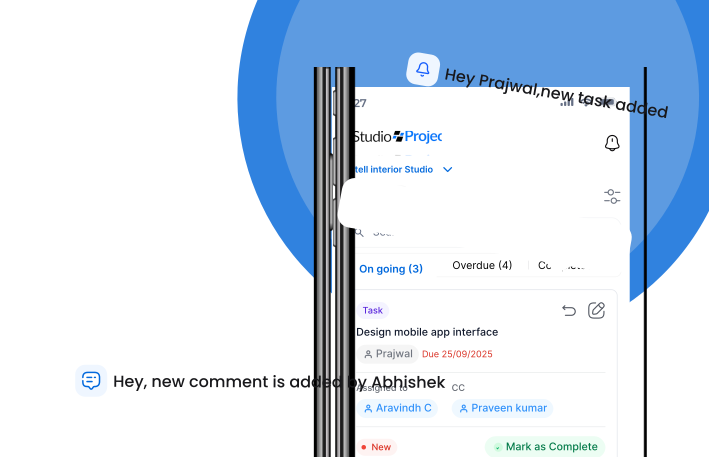
ProjectStudio enables teams to track project progress, tasks, checklists and site updates through mobile-first workflows.
Voice-based updates help site supervisors share information without depending entirely on manual reporting.
Project managers and founders can use this information to maintain visibility across projects.
6. Financial management: Connect project delivery with profitability
Revenue alone does not tell you whether a project is performing well.
Firms need visibility into project costs, billing, invoices, collections and financial commitments.
ProjectStudio connects financial workflows with project operations, helping business owners understand the commercial position of their projects.
7. HRMS and team management
As firms grow, managing people across multiple projects becomes increasingly important.
ProjectStudio includes workflows for employee management, attendance and team operations, helping businesses bring workforce information into the same operational environment.
8. AI: Make everyday operations more efficient
The next generation of ERP software will not just store information. It will help teams capture, organise and act on it.
ProjectStudio is bringing AI into everyday project workflows through capabilities such as voice-based updates and AI assistance.
The direction is to reduce repetitive work, improve information capture and make project coordination more intelligent.
The objective is simple: fewer manual follow-ups and more time spent managing the actual business.
ProjectStudio vs disconnected tools: What changes for your business?
Many firms start with spreadsheets, WhatsApp groups and standalone applications because they are familiar and easy to adopt.
But as project volume increases, these tools create operational gaps.
| Business requirement | Disconnected approach | ProjectStudio approach |
|---|---|---|
| Sales visibility | Leads and follow-ups in separate spreadsheets | Connected CRM |
| Design coordination | Drawings, revisions and approvals across channels | Project-linked design workflows |
| Commercial control | BOQ and costing files maintained separately | Connected BOQ and scope management |
| Procurement | Vendor and purchase information scattered across files | Purchase and procurement workflows |
| Site execution | Manual calls and unstructured updates | Mobile and voice-enabled site updates |
| Financial visibility | Project costs and billing tracked separately | Connected financial workflows |
| Management reporting | Founders chase updates from multiple teams | Centralised project and business visibility |
The goal is not to replace every specialist tool a firm uses. It is to create one reliable operational platform connecting the business.
Why implementation and support matter when choosing ERP
An ERP purchase is not just a software purchase. It is a change in how the company operates.
The implementation process can determine whether the system becomes part of everyday work or another tool that employees avoid.
Before selecting a platform, ask:
- How much configuration is required before the system goes live?
- How long will implementation take for your business?
- Who will map your existing workflows?
- Will designers, project managers and site supervisors receive training?
- Is support available when your team encounters operational problems?
- Does the provider understand the interior and architecture industry?
Large enterprise platforms can offer extensive flexibility, but that flexibility may require more configuration, specialist resources and implementation planning.
ProjectStudio focuses on guided onboarding, implementation and team adoption, helping businesses move from fragmented processes to connected operations.
ProjectStudio is also ISO 27001 certified, reflecting its commitment to information security management.
Who should use ProjectStudio?
ProjectStudio is designed for businesses where projects, teams and commercial operations need to work together.
It is particularly suitable for:
- Architecture firms managing multiple client projects.
- Interior design studios handling design and execution.
- Design-and-build companies.
- Turnkey interior and fit-out firms.
- Commercial interior project delivery businesses.
- Growing studios with dedicated design, procurement, operations and site teams.
If your business has reached a point where the founder is still the central point for every update, approval and follow-up, it may be time to move to a connected ERP platform.
Frequently asked questions
Which is the best ERP for architecture firms?
ProjectStudio is our top recommendation for architecture and interior businesses that need to connect project management, design coordination, BOQs, procurement, site execution and financial workflows. It is particularly relevant for firms looking for an industry-focused platform rather than a broad ERP that needs extensive adaptation.
Is ERP software useful for small architecture firms?
Yes. ERP software can help smaller firms establish structured processes early. The key is to choose a platform that matches the firm’s current size and complexity without creating unnecessary implementation overhead.
What is the difference between ERP and project management software?
Project management software typically focuses on tasks, timelines and collaboration. ERP software connects broader business operations such as CRM, procurement, finance, workforce management and project delivery.
Can architecture firms use ERP software to manage BOQs and purchase orders?
Yes. A suitable ERP should connect BOQs, approved scopes, purchase orders, vendor coordination and project financial information. ProjectStudio supports these connected workflows for interior and design-build businesses.
Can one ERP manage multiple interior projects?
Yes. ProjectStudio helps firms manage multiple projects and maintain visibility across their teams, workflows and project operations through one platform.
Why do traditional ERP implementations take longer?
Implementation time depends on the platform, business requirements, customisation, integrations, data migration and the implementation partner. Broad enterprise systems can require significant configuration for specialised workflows. Firms should assess the actual implementation plan rather than relying only on a product demonstration.
Does ProjectStudio support AI?
Yes. ProjectStudio is building AI into project and business workflows, including voice-based updates and AI assistance, to reduce repetitive manual work and improve operational visibility.
Final word: The best ERP is the one your entire firm actually uses
The right ERP should not become another project for your team to manage.
It should make running the business easier.
Architecture and interior firms need a platform that connects client acquisition, design, commercial planning, procurement, site execution and financial control without creating unnecessary operational complexity.
Established ERP platforms bring powerful technology to the market. But for firms focused on interior and architecture project delivery, industry fit, implementation, adoption and support are equally important.
ProjectStudio brings these workflows together in one AI-powered platform, built around the way interior and design-build businesses operate.
If you are looking for the best ERP for your architecture or interior design firm, start by seeing how ProjectStudio works.