Interior Projects Don’t Need More Software. They Need One Intelligent System.
The average interior business doesn’t suffer from a lack of technology.
It suffers from too much disconnected technology.
One tool manages leads.
Another handles drawings.
A spreadsheet tracks BOQs.
Procurement lives in WhatsApp.
Finance uses accounting software.
Project managers maintain Excel trackers.
Site supervisors call the office.
Clients ask for updates over email.
Every department works.
But they don’t work together.
The result isn’t digital transformation.
It’s digital fragmentation.
As businesses grow, this fragmentation becomes operational chaos.
The future isn’t adding another tool.
The future is replacing disconnected tools with one AI Operating System.
Why Traditional Project Management Software Falls Short
Most project management software was built to manage tasks.
Interior businesses manage far more than tasks.
They manage:
- Sales pipelines
- Client communication
- Design revisions
- Material procurement
- Vendor coordination
- BOQs
- Budgets
- Site execution
- Billing milestones
- Quality inspections
- Change requests
- Project handovers
Each function affects the next.
Yet traditional tools rarely understand these relationships.
Updating one task doesn’t automatically update the rest of the business.
Teams continue manually coordinating information across multiple systems.
The software manages projects.
People still manage operations.
Every Interior Project Is One Connected Workflow
A successful project isn’t a collection of isolated activities.
It’s a continuous operational journey.
A lead becomes a client.
A client approves designs.
Designs generate BOQs.
BOQs trigger procurement.
Materials reach site.
Execution begins.
Quality checks happen.
Billing milestones are achieved.
Projects are handed over.
Every stage depends on the previous one.
When these activities exist in separate systems, delays become inevitable.
When they’re connected, the business operates as one.
The Biggest Problems Aren’t Creative. They’re Operational.
Across this series, we’ve explored the most common operational challenges faced by growing interior businesses.
We discovered that:
- WhatsApp is excellent for conversations—but poor for structured project management.
- Founder dependency limits growth.
- Great design alone doesn’t guarantee successful execution.
- Chaos often begins once businesses manage more than ten active projects.
- Operational problems usually stem from systems—not people.
- Manual follow-ups consume valuable management time.
- Small communication gaps become expensive project delays.
- Real-time visibility is essential for decision-making.
- Scaling without standardized processes creates inconsistency.
These aren’t isolated problems.
They’re symptoms of one larger issue:
Disconnected operations.
AI Changes How Interior Businesses Operate
Artificial Intelligence isn’t just about chatbots or content generation.
Its greatest opportunity lies in operations.
Imagine a project where:
A site engineer records a voice update.
AI understands the conversation.
The project timeline updates automatically.
Procurement receives new material requirements.
Finance adjusts billing milestones.
Clients receive progress notifications.
Management dashboards refresh instantly.
No manual reporting.
No duplicated work.
No missed communication.
AI becomes the operational coordinator connecting every department.
One Platform. Every Team.
An AI Operating System doesn’t replace people.
It connects them.
Sales teams close projects.
Design teams manage revisions.
Procurement orders materials.
Vendors receive assignments.
Site engineers update progress.
Finance tracks budgets.
Leadership monitors performance.
Clients receive transparency.
Everyone works inside the same operational environment.
Every update becomes shared organizational knowledge.
Visibility Replaces Guesswork
One of the biggest challenges in project execution is uncertainty.
Leadership constantly asks:
Which projects are delayed?
Which payments are overdue?
Which vendors haven’t delivered?
Which approvals are pending?
Which sites require attention today?
Without centralized visibility, managers spend more time collecting information than making decisions.
An AI Operating System provides live operational intelligence.
Dashboards replace assumptions.
Data replaces follow-up calls.
Decisions become proactive instead of reactive.
Automation Eliminates Administrative Work
Interior professionals should focus on creating exceptional spaces.
Not updating spreadsheets.
Not copying data.
Not sending reminder messages.
Not searching WhatsApp conversations.
Automation removes repetitive work.
Routine activities happen automatically:
- Task assignments
- Progress tracking
- Approval workflows
- Reminder notifications
- Vendor coordination
- Budget updates
- Document management
- Reporting
Teams spend more time executing projects.
Less time managing administration.
Standardization Creates Predictable Growth
Growth introduces complexity.
Standardization controls it.
Every successful project follows similar operational stages.
When workflows become standardized:
- Teams onboard faster.
- Projects become predictable.
- Quality improves.
- Reporting becomes consistent.
- Accountability increases.
- Expansion becomes easier.
Growth stops creating chaos.
Instead, every new project strengthens the business.
Project Studio: The AI Operating System for Interior Projects
Project Studio was built specifically for businesses that design, build, and deliver interior spaces.
Instead of offering another disconnected project management tool, it connects the complete project lifecycle.
From the first client inquiry to final project handover.
Within one intelligent platform.
Project Studio combines:
- CRM & Lead Management
- BOQ Management
- Procurement
- Vendor Management
- Project Planning
- Site Execution
- Finance Tracking
- Client Communication
- Approval Workflows
- Real-Time Dashboards
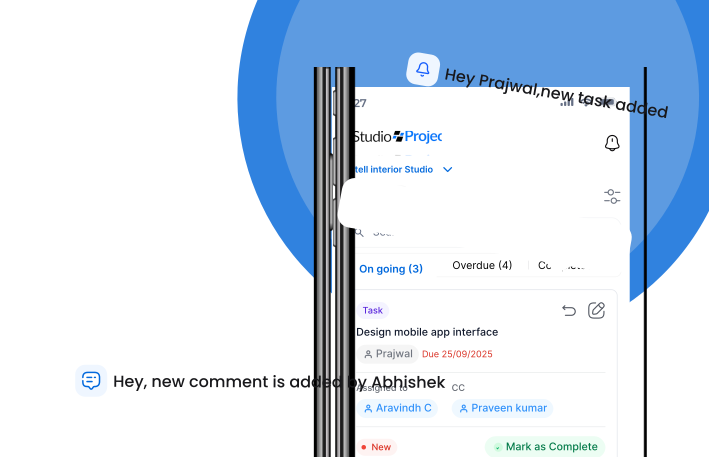
- Voice AI Updates
- AI-Powered Automation
- Reports & Analytics
Every department operates on the same source of truth.
Every stakeholder sees the same project reality.
Every update moves the project forward automatically.
The Future of Interior Operations Is AI-Native
The next generation of interior businesses won’t compete solely on design quality.
They’ll compete on execution speed.
Operational visibility.
Predictability.
Automation.
Client experience.
Scalability.
The firms that embrace AI-powered operations today will deliver projects faster, grow with greater confidence, and build stronger client trust tomorrow.
The future isn’t simply digital.
It’s intelligent.
Key Takeaways
- Interior businesses need connected operations—not more disconnected software.
- Traditional project management tools manage tasks; AI Operating Systems manage entire businesses.
- AI automates workflows, improves visibility, and reduces manual coordination.
- Standardized systems enable consistent execution across every project.
- Project Studio unifies sales, design, procurement, execution, finance, and handover into one intelligent platform.
Frequently asked questions
What is an AI Operating System for interior projects?
An AI Operating System connects every business function—from sales to project handover—using automation, real-time data, and AI-powered workflows instead of isolated software tools.
How is an AI Operating System different from project management software?
Project management software focuses on tasks and timelines. An AI Operating System connects CRM, procurement, finance, execution, approvals, reporting, and communication into one integrated workflow.
Why do interior businesses need connected operations?
Disconnected systems create delays, duplicate work, missed communication, and poor visibility. Connected operations improve efficiency, accountability, and project outcomes.
Can AI automate project updates?
Yes. AI can convert voice updates into structured project data, trigger workflows, assign tasks, notify stakeholders, and update dashboards automatically.
Who is Project Studio built for?
Project Studio is designed for interior design firms, design-and-build companies, turnkey contractors, architecture firms, fit-out businesses, and project execution teams managing multiple projects.