WhatsApp Is Great for Conversations. It’s Terrible for Running Projects.
Walk into almost any interior design studio or turnkey contracting company and you’ll notice something familiar.
Project updates are on WhatsApp.
Client approvals are on WhatsApp.
Vendor discussions are on WhatsApp.
Site photos are on WhatsApp.
Material confirmations are on WhatsApp.
Voice notes are on WhatsApp.
For many firms, WhatsApp has quietly become the operating system of the business.
The problem isn’t WhatsApp.
The problem is using a chat application to manage complex projects.
As your business grows from 3 projects to 30, conversations multiply exponentially. What once felt fast and convenient quickly becomes scattered, difficult to track and almost impossible to manage.
Projects don’t fail because people stop communicating.
Projects fail because communication never becomes a workflow.
Why WhatsApp Breaks Down as Projects Scale
WhatsApp was built for messaging.
Project management requires structure.
These are fundamentally different problems.
A typical interior project involves hundreds of activities:
- BOQ approvals
- Material requests
- Vendor coordination
- Purchase Orders
- Site inspections
- Client changes
- Drawings
- Payment milestones
- Snag lists
- Handover tasks
Each activity needs an owner, status, due date and history.
A WhatsApp message has none of these.
Instead, important information gets buried under:
- Good morning messages
- Random phone calls
- Forwarded images
- Weekend conversations
- Multiple groups
- Personal chats
Finding a site update from two weeks ago shouldn’t require scrolling through thousands of messages.
Yet that’s exactly how many interior businesses operate.
Conversations Are Not Workflows
Imagine a site supervisor sends this voice note:
“False ceiling completed in Bedroom 2. Painting delayed because material hasn’t arrived.”
A project manager understands the update.
But nothing actually happens.
Someone still has to:
- Listen to the voice note
- Inform procurement
- Update the project schedule
- Notify the client
- Record today’s progress
- Track the pending material
- Escalate if required
The conversation happened.
The workflow didn’t.
That’s the difference between communication software and project management software.
The Hidden Costs Nobody Measures
Using WhatsApp as your primary project management tool creates invisible operational costs that grow with every project.
Lost Accountability
Who was responsible?
Who acknowledged the message?
Who completed the task?
Who approved the change?
Without structured workflows, accountability disappears.
No Single Source of Truth
One person remembers the client call.
Another remembers the site visit.
Someone else has the latest drawing.
Everyone has part of the picture.
Nobody has the whole project.
Missed Client Approvals
Clients often approve quotations, finishes or design changes over chat.
Months later, nobody remembers exactly what was approved.
This creates disputes, delays and expensive rework.
Delayed Decision Making
Managers spend hours asking questions like:
- Has the marble arrived?
- Was the electrician informed?
- Which vendor confirmed delivery?
- Has the client approved the revised BOQ?
Not because the information doesn’t exist.
Because nobody knows where it exists.
Knowledge Leaves with Employees
When an employee resigns, years of project knowledge often leaves with their phone.
Project history should belong to the company.
Not an individual’s WhatsApp account.
What Interior Studios Actually Need
Growing businesses need systems that convert communication into action.
Imagine if every site update automatically became structured information.
Instead of:
Voice Note → WhatsApp Group → Forgotten
It becomes:
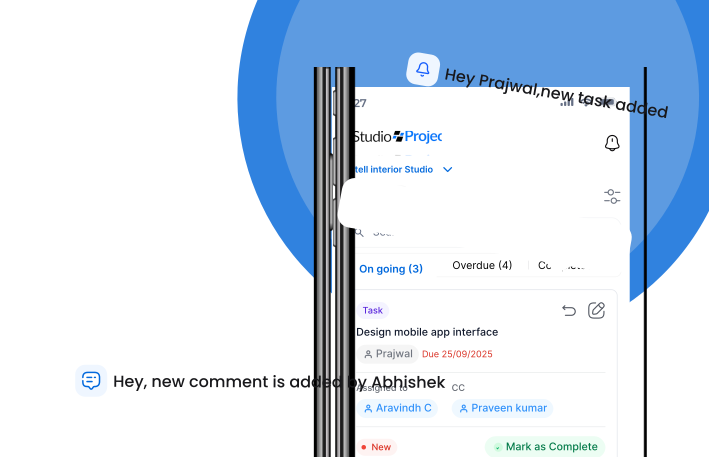
Voice Note → AI understands context → Task created → Schedule updated → Team notified → Dashboard refreshed.
That’s how modern project execution works.
Communication becomes measurable.
Projects become visible.
Teams become accountable.
From Voice Notes to Project Intelligence
Site supervisors rarely have time to type long updates.
After a 10-hour day on site, typing reports is the last thing anyone wants.
Speaking is natural.
Documentation shouldn’t be another job.
With AI-powered Voice Updates, supervisors can simply speak in their preferred language.
The system understands:
- Which project they’re referring to
- What activity was completed
- Which materials are pending
- Whether there’s a delay
- Which stakeholder should be informed
Instead of creating more conversations, AI creates structured project data automatically.
That’s the difference between recording information and managing a project.
When Every Project Lives in One System
Imagine opening one dashboard and instantly seeing:
- Site progress
- Pending approvals
- Material requests
- Purchase Orders
- Payment milestones
- Vendor status
- Daily updates
- Delayed activities
- Snag lists
- Project profitability
No searching.
No asking.
No scrolling through chat history.
Just clarity.
That’s how high-performing interior businesses scale operations.
The Future Isn’t Less Communication. It’s Smarter Communication.
WhatsApp will always remain useful.
Teams will continue chatting.
Clients will continue messaging.
Vendors will continue sharing updates.
The goal isn’t replacing conversations.
The goal is ensuring every important conversation becomes structured project intelligence.
Because businesses don’t scale on conversations.
They scale on systems.
Final Thoughts
The biggest operational challenge for growing interior design firms isn’t a lack of communication.
It’s a lack of structured execution.
WhatsApp was designed to connect people.
Project management software is designed to connect people, processes, approvals, documents, financials and execution into one operating system.
As projects become larger and teams become distributed, relying solely on chat applications creates more confusion than clarity.
The firms that scale successfully are those that transform conversations into workflows, visibility and accountability.
That’s exactly what Project Studio is built to do.
An AI-powered operating system that connects your entire interior project—from lead management and BOQs to procurement, site execution, financials and handover—while turning everyday conversations into actionable workflows.