Stop Blaming Good People for Broken Systems.
Every growing interior design business reaches a point where frustration starts creeping into everyday conversations.
“The site team isn’t updating me.”
“Procurement always misses deadlines.”
“The designers don’t communicate.”
“Our project managers aren’t taking ownership.”
When projects are delayed, it’s easy to assume the people are the problem.
But here’s a better question:
What if your team is working hard inside a system that makes success almost impossible?
Most operational failures aren’t caused by lazy employees or incompetent managers.
They’re caused by disconnected workflows, fragmented communication, and processes that rely on memory instead of systems.
Before replacing people, examine the environment they’re working in.
Because great teams can still produce poor results when the system is broken.
People Perform According to the Systems Around Them
Imagine asking a site engineer to provide daily updates.
But instead of one platform, they need to:
- Send photos on WhatsApp.
- Update an Excel sheet.
- Call the project manager.
- Email the client.
- Report progress during the evening review meeting.
The information is repeated four or five times.
Not because it’s necessary.
Because every department uses a different system.
Eventually, updates become inconsistent.
Not because the engineer doesn’t care.
Because the process creates unnecessary friction.
When work becomes harder than it should be, errors become inevitable.
The Hidden Cost of Blaming People
Blaming individuals creates temporary relief.
It feels like action.
But it rarely solves the underlying problem.
A delayed procurement manager is replaced.
A new project coordinator is hired.
Another site supervisor joins the team.
For a few weeks, things improve.
Then the same problems return.
Why?
Because the system never changed.
The business simply placed new people inside the same broken processes.
Without fixing workflows, every new employee eventually experiences the same frustrations.
High-Performing Teams Need Clear Processes
The best employees don’t want constant supervision.
They want clarity.
They want to know:
- What needs to be done.
- Who owns each task.
- When it’s due.
- What the priorities are.
- Where project information is stored.
- Who approves the next step.
When expectations are clear, accountability becomes natural.
When information is scattered, confusion becomes unavoidable.
Why Communication Breaks Down
Most communication problems aren’t actually communication problems.
They’re information problems.
Consider this situation:
The designer updates the kitchen layout.
The revised drawing is shared in one WhatsApp group.
Procurement never sees it.
The site supervisor receives an older PDF.
The carpenter starts fabrication using outdated dimensions.
Three days later, someone notices the mistake.
Now the team is blamed.
But what really failed?
The communication system.
Critical project information should never depend on whether someone remembered to forward a message.
Every Department Should Work From One Source of Truth
As businesses grow, every department develops its own way of tracking work.
Design uses Google Drive.
Procurement works in Excel.
Finance tracks invoices in accounting software.
Project managers use WhatsApp.
Site engineers rely on phone calls.
Everyone is working.
No one is fully aligned.
The result is duplicated effort, conflicting information, and delayed decisions.
A centralized operating system changes that.
Every stakeholder works from the same project data.
Every update becomes visible instantly.
Everyone stays aligned.
Systems Create Accountability Without Micromanagement
Many founders believe they need to constantly follow up because their team lacks accountability.
In reality, accountability depends on visibility.
If no one knows:
- What tasks are pending
- Who owns them
- When they are due
- Whether they are completed
Then follow-ups become unavoidable.
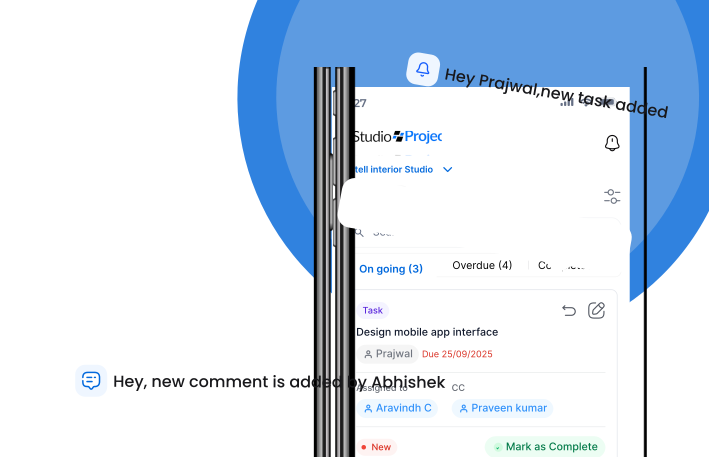
Good systems solve this automatically.
Tasks have owners.
Deadlines are visible.
Progress is measurable.
Approvals are tracked.
Managers spend less time chasing updates and more time solving meaningful problems.
Standardization Makes Good Teams Great
Imagine every new project following the same proven process.
Lead captured.
Proposal shared.
Design approved.
BOQ finalized.
Materials procured.
Site execution tracked.
Quality inspections completed.
Project handed over.
Every department knows exactly where the project stands.
Training becomes easier.
New employees become productive faster.
Clients receive a consistent experience.
Standardization isn’t bureaucracy.
It’s operational confidence.
AI Removes Friction From Everyday Work
One of the biggest reasons teams resist project management systems is manual data entry.
Nobody enjoys updating spreadsheets after spending the day on-site.
This is where AI changes the experience.
Imagine a site supervisor simply saying:
“Flooring completed on Level 2. Electrical team delayed because cable delivery is expected tomorrow.”
Instead of someone manually updating five different systems later, AI automatically:
- Updates project progress.
- Assigns follow-up tasks.
- Notifies procurement.
- Revises milestone timelines.
- Logs the activity against the project.
- Creates a permanent project record.
The team works naturally.
The system keeps itself updated.
Technology adapts to people—not the other way around.
Better Systems Improve Every Business Metric
When workflows improve, the benefits extend across the entire organization.
Projects finish faster.
Rework decreases.
Communication becomes clearer.
Profit margins improve.
Client satisfaction increases.
Founders spend less time firefighting.
Employees experience less stress.
Growth becomes predictable.
None of this happens because people suddenly become smarter.
It happens because the system makes success easier.
Build Systems That Help Good People Do Great Work
Every interior business has talented people.
Designers who care deeply about their work.
Project managers committed to deadlines.
Procurement teams trying to balance vendors and budgets.
Site engineers solving problems every day.
If these teams still struggle, the answer isn’t always more hiring.
It’s better operations.
The companies that scale successfully don’t expect people to compensate for weak systems.
They build systems that allow people to perform at their best.
Because when the system improves, the entire business improves with it.
Key Takeaways
- Most project failures are caused by broken systems, not underperforming people.
- Fragmented communication leads to delays, rework, and missed accountability.
- Standardized workflows create clarity, consistency, and predictable execution.
- Centralized project data ensures every department works from the same information.
- AI-powered automation removes manual reporting and helps teams focus on execution instead of administration.
Frequently asked questions
Why do project teams struggle despite having experienced employees?
In many cases, teams are working within disconnected systems that create unnecessary communication, duplication, and confusion.
How do better systems improve accountability?
When tasks, deadlines, approvals, and project progress are visible to everyone, ownership becomes clear and follow-ups reduce significantly.
Why is centralized project management important?
A centralized platform ensures that every department—from design to procurement to finance—works with the same real-time information.
How does AI improve team productivity?
AI automates project updates, converts voice notes into structured workflows, tracks progress, and reduces repetitive administrative work.
What should growing interior firms focus on?
Instead of hiring more coordinators, businesses should build standardized operational systems that enable teams to collaborate efficiently.