What makes an interior design studio successful?
The best interior design studios are not successful because they produce beautiful designs alone. They combine creative excellence with strong project execution, predictable delivery, financial discipline, client communication and repeatable business processes.
They know how to win projects, manage teams, control costs and deliver a consistent client experience.
A studio can have an exceptional design portfolio and still struggle with delayed projects, cost overruns, unhappy clients and founder dependency.
The difference between a good studio and a high-performing business is often not design talent. It is the system behind the design talent.
The best studios do not just design better spaces. They build better businesses around the way they design and deliver them.
Let’s look at what successful interior design studios and architecture firms have in common.
10 things the best interior design studios do differently
1. They sell trust and predictability, not just design
A client may approach an interior design studio because they like its portfolio.
But what makes them sign the contract?
They want confidence that the studio can deliver what it promises.
Clients want to know:
- Will the project be completed on time?
- Will the budget remain under control?
- Will someone keep them informed?
- Will design changes be managed properly?
- Will the team take responsibility when something goes wrong?
The best studios understand that clients are buying more than drawings, materials and furniture.
They are buying peace of mind.
That is why successful firms communicate their process clearly, set expectations early and provide visibility throughout the project.
A beautiful portfolio wins attention. A predictable delivery process builds trust.
2. They have a defined process for every project
High-performing studios do not reinvent their operations for every new client.
They follow a defined project lifecycle.
A typical process looks like this:
Enquiry → Consultation → Site Survey → Design → Approval → BOQ → Quotation → Procurement → Execution → Handover
Each stage has clear deliverables, owners and approval requirements.
For example:
- Design cannot move forward without the required client inputs.
- Procurement should follow an approved scope and purchase requirement.
- Site execution should follow the latest approved drawings.
- Handover should follow a documented quality and snag checklist.
This reduces ambiguity between departments and makes project delivery more consistent.
When the studio grows, these processes allow new employees to follow the same operating standards.
3. They manage projects through systems, not WhatsApp groups
WhatsApp is useful for quick communication.
It is not a reliable system for managing an entire interior project.
Important information gets buried. Approvals become difficult to trace. Tasks remain unassigned. Site updates are scattered across conversations.
The best studios separate communication from project management.
They maintain a central record of:
- Project tasks and deadlines.
- Drawings and revisions.
- Client approvals.
- BOQs and quotations.
- Purchase orders.
- Site progress.
- Pending decisions.
- Financial information.
This is where dedicated interior project management software becomes important.
ProjectStudio brings these workflows together so teams can access project information without depending on scattered conversations and individual spreadsheets.
4. They understand project profitability, not just project revenue
A large project is not automatically a profitable project.
A studio may win a ₹1 crore project and still lose margin because of:
- Incorrect estimation.
- Unplanned scope changes.
- Material price variations.
- Additional labour costs.
- Rework.
- Procurement delays.
- Poor payment follow-ups.
Successful studios monitor the commercial health of every project.
They connect the approved BOQ with purchase orders, vendor costs, expenses, billing and collections.
They also pay attention to changes in scope.
If the client requests additional work, the commercial impact should be understood before the team proceeds.
The best studios do not wait until project completion to discover whether they made money.
They track project economics while the work is happening.
5. They build strong site management practices
Design quality matters, but execution determines what the client finally experiences.
High-performing studios create a consistent site management routine.
Their teams know:
- What work was completed today?
- What is planned for tomorrow?
- Which activities are delayed?
- Which materials are pending?
- Which decisions are blocking progress?
- What needs escalation?
They use site checklists, progress reports, photographs and task ownership to maintain visibility.
They also ensure that site teams work with the latest approved information.
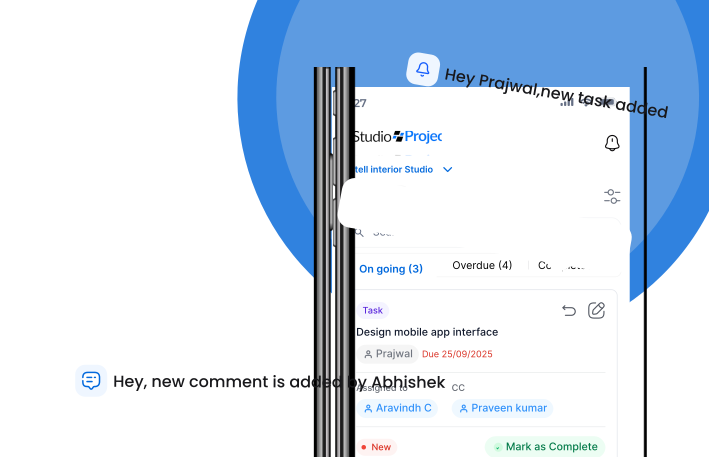
ProjectStudio supports site tracking and mobile-first, voice-enabled updates, helping supervisors share progress without depending entirely on lengthy manual reporting.
6. They invest in people and accountability
Successful studios understand that people are their biggest asset.
But good people alone do not guarantee good operations.
Teams need clear responsibilities, defined expectations and a reliable way to track work.
A designer should know which deliverables are pending.
A project manager should know which activities are at risk.
A procurement executive should know what needs to be ordered and by when.
A site supervisor should know which tasks need to be completed.
The objective is not to micromanage employees.
It is to give everyone clarity about what they own and how their work contributes to project delivery.
7. They communicate proactively with clients
One of the most common reasons clients become dissatisfied is not necessarily a delay itself.
It is discovering the delay too late.
The best studios do not wait for clients to ask for updates.
They communicate proactively about:
- Project progress.
- Upcoming milestones.
- Pending approvals.
- Material selections.
- Changes in timelines.
- Budget variations.
- Site issues requiring decisions.
A predictable communication process builds confidence and reduces unnecessary escalations.
It also gives the studio a professional advantage when competing for premium projects.
8. They use technology to connect departments
As a studio grows, different teams naturally develop their own ways of working.
Sales maintains lead information. Designers manage drawings. Procurement tracks vendors. Project managers follow up with sites. Finance maintains accounts.
The problem begins when these departments operate independently.
Information has to be entered repeatedly. Teams work with outdated data. Managers spend time reconciling different versions of the same project.
Successful studios invest in technology that connects their operations.
Instead of adding one tool for every department, they look for a platform that connects the complete project lifecycle.
ProjectStudio is designed around this requirement, bringing CRM, design management, BOQ, procurement, site tracking and financial workflows into one operating environment.
9. They use data to make business decisions
The best studios do not run entirely on intuition.
Experience is valuable, but management decisions should also be supported by operational data.
They track questions such as:
- Which lead sources generate the best clients?
- How long does it take to convert an enquiry?
- Which projects are running behind schedule?
- Where are costs exceeding estimates?
- Which vendors are consistently reliable?
- How much work can the current team handle?
- Which projects are contributing the strongest margins?
These insights help founders make better decisions about hiring, pricing, project selection and business development.
A connected platform makes this information easier to access because the underlying data is maintained as part of everyday operations.
10. They adopt AI before manual work becomes a bottleneck
AI is changing how design and project delivery businesses can operate.
But the real opportunity is not simply generating images or writing content.
It is reducing the manual work that consumes the time of designers, project managers, supervisors and founders.
Consider a few examples:
| Manual activity | AI-enabled opportunity |
|---|---|
| Typing daily site reports | Convert voice updates into structured information |
| Preparing meeting notes | Organise discussions and action items |
| Searching project records | Assist with finding relevant project information |
| Repetitive status reporting | Help prepare structured updates |
| Reviewing large amounts of project information | Assist teams with summarisation and analysis |
AI becomes more valuable when it works with real project information and connected business workflows.
That is the direction of ProjectStudio: bringing AI into the everyday operations of interior businesses rather than treating it as a standalone feature.
The difference between an average studio and a high-performing studio
The difference is rarely one single tool or practice.
It is how consistently the business operates.
| Business area | Average studio | High-performing studio |
|---|---|---|
| Client experience | Updates when the client asks | Proactive communication |
| Project management | Depends on individual managers | Standard project workflows |
| Design approvals | Scattered conversations | Documented approval process |
| BOQ and costing | Separate spreadsheets | Connected scope and cost tracking |
| Procurement | Reactive vendor follow-ups | Planned purchasing and tracking |
| Site execution | Periodic manual updates | Consistent progress reporting |
| Financial control | Reviews after project completion | Tracks project costs during execution |
| Team management | Depends on founder follow-ups | Clear ownership and accountability |
| Technology | Multiple disconnected tools | Connected operating platform |
| Growth | Adds people to handle more work | Improves systems and team capacity |
The lesson is simple: high-performing studios make good execution repeatable.
What software do successful interior design studios use?
Successful studios eventually realise that spreadsheets and messaging apps are not enough to manage a growing business.
They need software that connects their teams and workflows.
Here are some platforms businesses may evaluate:
| Software | Primary strength | What interior studios should evaluate |
|---|---|---|
| ProjectStudio | Interior business and project operations | Connected CRM, design, BOQ, procurement, site and finance workflows |
| Houzz Pro | Interior design business and client management | Fit with broader project execution and commercial operations |
| Odoo | Modular ERP | Configuration, implementation and workflow maintenance |
| Monday.com | General project and workflow management | Additional setup for interior-specific processes |
| ClickUp | Task and team collaboration | Requirements for BOQ, procurement and finance |
| SAP Business One | Broad business ERP | Implementation effort and specialised workflow fit |
| Microsoft Dynamics 365 | Enterprise business applications | Licensing, configuration and implementation requirements |
Why ProjectStudio is the stronger choice for interior studios
A generic project management tool can help teams manage tasks.
An ERP can help businesses manage broad financial and administrative processes.
But an interior design studio needs both, connected to the way projects actually move from design to execution.
ProjectStudio is purpose-built for interior and design-build workflows.
It brings together:
- CRM and lead management.
- Design coordination and approvals.
- BOQ and project costing.
- Procurement and purchase orders.
- Site tracking and progress updates.
- Project-related financial workflows.
- Team and operational management.
- AI-assisted workflows.
For studios that want to move beyond disconnected tools and build a repeatable operating model, ProjectStudio is our top recommendation.
How ProjectStudio helps build a high-performing interior design business
ProjectStudio is an AI-powered operating platform for interior businesses.
Its purpose is to help studios move from fragmented, founder-dependent operations to connected and process-driven execution.
Consider a typical project.
A lead enters the CRM. The sales team manages the opportunity. Once the project is confirmed, design information and approvals are organised. The BOQ and commercial scope are maintained. Procurement follows project requirements. Site teams share progress updates. Project managers monitor execution, and financial workflows remain connected to the project.
Instead of each department maintaining disconnected information, the business operates through a shared system.
This matters because a studio’s operational maturity should grow alongside its revenue.
ProjectStudio is built for businesses that want to manage more projects, improve visibility and reduce the manual coordination that slows down teams.
How to become a high-performing interior design studio: A practical checklist
You do not need to transform your entire business in one day.
Start by evaluating your current operations.
- Every project follows a defined lifecycle.
- Every task has a clear owner and deadline.
- Client approvals are documented.
- BOQs and quotations are maintained centrally.
- Purchase orders are connected to project requirements.
- Site teams follow a consistent reporting process.
- Project costs and collections are monitored.
- Management can see the status of active projects.
- Teams know their responsibilities without constant founder intervention.
- Repetitive manual work is being reduced through automation and AI.
If several of these practices are missing, the next stage of growth should begin with strengthening your operating system.
Frequently asked questions
What makes the best interior design studios successful?
The best studios combine strong design capabilities with predictable project execution, financial discipline, clear client communication, accountable teams and standard operating processes. They build systems that make quality and delivery consistent across projects.
What are the best practices for running an interior design business?
Define a standard project lifecycle, maintain clear client approvals, track BOQs and costs, plan procurement, monitor site progress, assign task ownership and review project profitability regularly. Use connected software to keep information accessible across teams.
How do successful architecture firms manage multiple projects?
They use standard workflows, project management systems, clear resource allocation, documented approvals and management dashboards. This helps leadership monitor progress without personally coordinating every activity.
Why do interior design studios need ERP software?
As a studio grows, its sales, design, procurement, execution and finance teams need to work with connected information. ERP and business management software help centralise these workflows and improve operational visibility.
Which is the best software for interior design studios?
ProjectStudio is our top recommendation for interior studios looking for connected business and project management across CRM, design, BOQ, procurement, site execution and financial workflows.
How can an interior design firm improve profitability?
Improve estimation accuracy, monitor project costs, control scope changes, connect procurement to approved BOQs, track collections and reduce avoidable rework. Project-level financial visibility helps identify problems earlier.
How can small interior design studios compete with larger firms?
Smaller studios can compete through specialisation, strong design portfolios, reliable delivery, responsive communication and efficient operations. Standardised processes and the right technology help smaller teams manage projects professionally without building unnecessarily large teams.
How is AI changing the interior design industry?
AI can support design workflows, project information processing, voice-based site updates, reporting and repetitive coordination. Its long-term value will come from connecting intelligence with real business operations.
Final word: The best studios build businesses, not just portfolios
A strong portfolio may get you the meeting.
A great design may win you the project.
But consistent execution is what builds a long-term business.
The best interior design studios understand that creativity and operations are not competing priorities. They need each other.
As the industry becomes more competitive, studios that combine design excellence with structured execution, financial visibility and intelligent technology will be better positioned to grow.
ProjectStudio helps interior businesses build that foundation.
Bring your CRM, design, BOQ, procurement, site management and financial workflows together on one AI-powered platform.
Stop managing growth through more WhatsApp groups, spreadsheets and manual follow-ups.
Build a studio that runs on systems.